Destinations / Atacama
Atacama Flowering Desert: 2026 bloom, parks, buses, prices
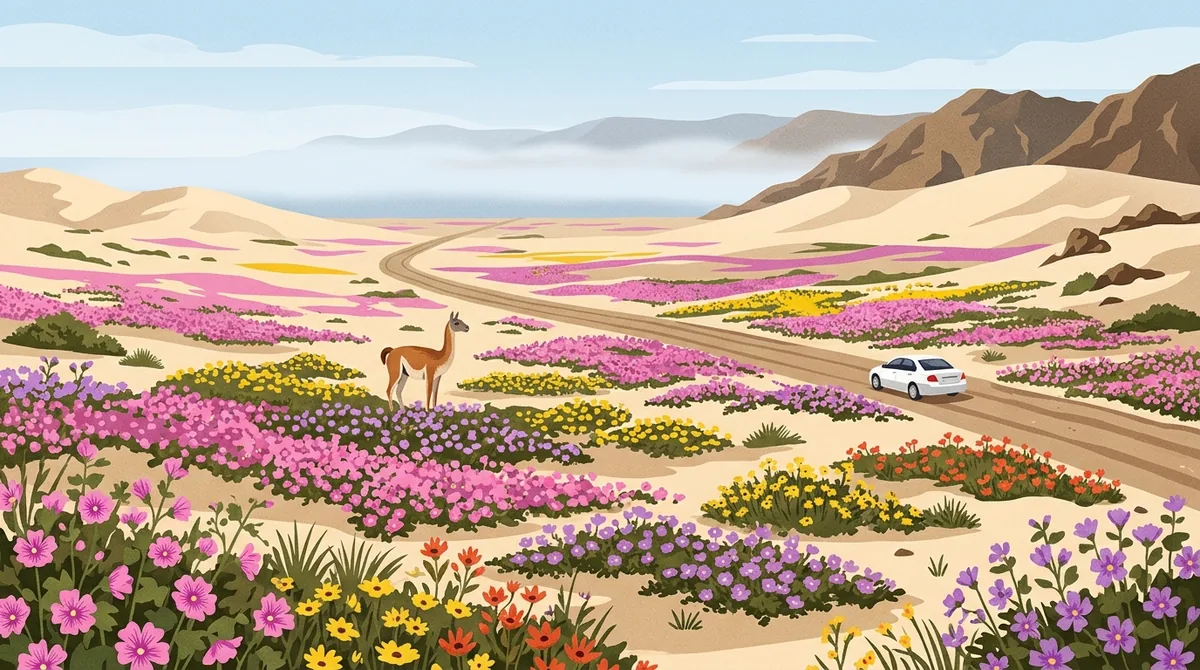
Every few years rain wakes the seeds of the coastal Atacama Desert and covers it in flowers. 2026 was one of the biggest blooms in decades, but reports in mid-November said it was starting to fade. Spanish speakers call it the desierto florido. This guide says what we know about the bloom now, where the parks are, what they cost, how to get there and how to plan for the next one.
Quick answer
Reports through 15 November say 2026's bloom, among the biggest in decades after El Niño rains, is starting to fade, and hardy species could last to January. We found no official bulletin for 10 to 18 November, so ask CONAF before you go. A 2023 article says blooms recur every three to ten years.
Is the bloom still on?
We cannot confirm what remains. Chile Travel expected full bloom from early September, with its greatest expression in the second half of October and possibly into November, while Radio Agricultura quoted a biologist for a peak in the first or second week of October and Meteored for late September to mid-October, so the peak was projected, not observed here. NPR, on 08-11-2026, said the bloom was projected to last until mid-November, with each species living roughly two to three months, and a caption that the blooms last only a few weeks before they dry out. A 15-11-2026 report attributes to CONAF that most flowers will begin to disappear, although some hardy ones could last until January, and Ecoticias, on 02-11-2026, said most would be gone during November, with some species lasting to January. We read all the sources on 18-11-2026, so we have nothing for 19 to 22 November.
CONAF's own page for the 2026 bloom, modified 14-09-2026, gives only recommendations. It does not say which sectors still have flowers or until when. Atacama Noticias' latest note, from 02-11-2026, concerns damage to protected species, and we found no official bulletin dated 10 to 18 November. So we cannot tell you where flowers remain today. Ask the CONAF office in Vallenar or Copiapó before you drive.
Why 2026 was exceptional
- The rain: an El Niño pattern brought heavy rain, and NPR says some areas had the heaviest rainfall since records began in the 1950s. CONAF biologist César Pizarro told the Associated Press that some locations received 160, 180 and 190 millimeters, and Ecoticias says Vallenar had up to 183.5 millimeters between July and September. Chile Travel says the plants need roughly 15 to 30 millimeters, mainly in June and July, plus enough cold hours.
- The size: CONAF first projected up to 15,000 square kilometers. The Associated Press, on 01-10-2026, gave an estimated 17,000, similar in size to the Santiago region, and reported that CONAF projects it to be the most intense and extensive since 1997. Travel and Tour World, a trade-news site, gave on 05-10-2026 a minimum projected area of 17,667 square kilometers, so the figures run from 15,000 to at least 17,667. A November report attributes to CONAF the equivalent of 23% of the Atacama region. NPR called it the largest and most colorful in 30 years, and perhaps ever.
- The flowers: more than 200 species, according to AP and NPR. Chile Travel and El Desconcierto name añañucas, suspiros and pata de guanaco, and NPR says the garra de león grows along just a few miles of coast and nowhere else.
- The cost: the same rains caused floods in July and August that damaged or destroyed dozens of homes and forced hundreds of people to evacuate, according to NPR.
- The visitors: the Llanos de Challe administrator told NPR the park normally gets about 10,000 visitors a year and 15,000 in a few weeks, and the tourism board expected about 300,000 overnight trips in the two months.
- The park, since 2023: NPR says a national park for the bloom was created in June 2023, protecting 141,000 acres (about 57,000 hectares, our conversion), and that the governor is seeking UNESCO World Heritage status. Travel and Tour World, a trade-news site, gives 57,107 hectares, 30 kilometers south of Copiapó and 85 kilometers north of Vallenar.
Where to see it
| Place | Hours | Entry | Access and notes |
|---|---|---|---|
| Desierto Florido National Park, Copiapó | Tuesday to Sunday, open 9:00, last entry and closing 18:00 (CONAF, modified 08-10-2026) | No price, categories or reservation on CONAF's page, and the park is not listed on Pases Parques | 30 km south of Copiapó, 57,107 hectares. From Copiapó take route C-30 toward Route 5, and at the Nantoco junction turn west onto C-382. In the bloom season vehicles may use only C-382, the other roads are for walking, and you park in the enabled area, while El Desconcierto says the park has no parking. CONAF does not state the condition of C-382. No visitor infrastructure |
| Llanos de Challe National Park, Huasco | Tuesday to Sunday, 09:00 to 18:00, last entry 17:30 (Pases Parques, undated) | Chilean adult CLP 5,000, foreign adult CLP 11,000, youth 13 to 17 CLP 3,400 and 5,500, and in the page's data children free for Chileans with no foreign price stated, and seniors 60 and over and people with disabilities free for Chileans and CLP 11,000 for foreigners. Slots are sold in advance on Pases Parques. The fee does not include the restrooms, which are outsourced, and no amount is stated | From Huasco by coastal route C-360 for 40 km, or by the gravel route C-440 that starts 40 km north of Vallenar. CONAF says both are in good condition and need no 4x4, with a slippery bischofite surface in damp conditions on the coastal road, and about 1.5 hours from Vallenar by either |
| Pan de Azúcar National Park | Tuesday to Sunday, 09:00 to 18:00, last entry 18:00 (Pases Parques, undated) | Chilean adult from CLP 5,500, foreign adult CLP 11,000, youth 3,400 and 5,500, children free for Chileans and no foreign price stated | Routes C-120 from Chañaral (27.1 km), C-112 and C-110 (CONAF). We found no word on flowers there this year |
Only the Llanos de Challe adult prices are visible on screen at Pases Parques, and the other values come from the page's price data, which we treat as less certain. Sources conflict on distances: Chile Travel puts Llanos de Challe 90 kilometers northwest of Vallenar and a 2025 Meteored article puts it 98 kilometers from Vallenar, 140 from Copiapó and 38 from Huasco. That 2025 article also gave hours of 9:00 to 15:00, prices of $4,700 and $10,400 with no currency code, and route C-470, which CONAF's 2026 page does not mention, so we use the 2026 sources. The page prints the adult bracket as 11 to 64 years, names a 9:00 slot of 7 hours for 28-11-2026 and shows 9,993 places available. NPR also names the Canto del Agua area, Chile Travel names Caleta Chañaral de Aceituno and sectors of Totoral, and Radio Agricultura mentions the coastal plains of Caldera, and we found no hours or prices for them. Travel and Tour World (05-10-2026), a trade-news site, lists four official road routes, which we did not confirm on an official page. Several continue beyond C-382, and CONAF says that in the bloom season vehicles may use only C-382 in the Desierto Florido National Park, so follow CONAF. The routes are: about kilometer 777 of Route 5, then C-382 toward the park, then C-370 toward Barranquilla and the coastal C-10; Route 5 to C-390 toward Bahía Salada, then C-10; C-440 toward Llanos de Challe and Carrizal Bajo; and C-46 then C-480 to Caleta Los Bronces. Matador Network, in 2022 and so older than 18 months, describes three trails of 1.5 to 6.8 miles at Llanos de Challe, including an easy interpretive loop of less than two hours, and says vehicles are not allowed on the dunes. It gives an entry of 3,700 CLP, which is out of date next to the current CLP 5,000, and it places the park in the Coquimbo region, which conflicts with every other source, so treat its trail details with caution. GoChile, a tour operator's undated page, gives other hours of 8:30 to 17:30 in winter and 8:30 to 20:00 in summer and lists campsites near the park station, and its Vallenar CONAF office is at Merced 731, phone 51-611555.
Getting there and tours
Radio Agricultura quotes Copiapó, Vallenar and Caldera as the base towns. By our reading of CONAF and Chile Travel, Vallenar or Huasco serves Llanos de Challe, Copiapó the Desierto Florido National Park and Chañaral Pan de Azúcar. Chile Travel lists the Copiapó airport (CPO) with direct flights from Santiago and 75 kilometers, about an hour, from the terminal to the coast by private vehicle or transfer, and about 10 hours by car from Santiago to Chañaral. Our San Pedro de Atacama guide covers the northern desert.
| Bus route, 28-11-2026 | Companies and departures | Fares from |
|---|---|---|
| Santiago to Vallenar, about 10 hours | PlussChile 9, Condor Bus 9, Cikbus Elité 3, Buses Romani 3 | From $21,600 (Cikbus Elité, low-cost salón cama) to $43,300 (PlussChile, Premium 180°) |
| Santiago to Copiapó, about 11 hours | PlussChile 8, Condor Bus 9, Cikbus Elité 5, Buses Romani 3, Buses Paravias 1 | From $24,400 (Cikbus Elité, low-cost semi cama) to $36,000 (PlussChile, salón cama) |
| Copiapó to Vallenar, about 2 hours | PlussChile 6, Condor Bus 6, Cikbus Elité 3 | From $9,000 (Condor Bus, semi cama) to $20,600 (PlussChile, salón cama) |
These come from recorrido.cl, searched on 18-11-2026. The fares are printed with a dollar sign and no currency code, which we read as pesos. The page gives only an average duration per route, while Radio Agricultura gives 8 to 9.5 hours to Vallenar and 10 to 11.5 to Copiapó, from Terminal Alameda, San Borja, Las Condes or near Metro Escuela Militar, and Radio Agricultura's figures of 14-10-2026 (Vallenar from $21,900, Copiapó from $24,400, Caldera from $30,600) are close to them.
- No public transport to the parks: a 2025 Meteored article says none reaches Llanos de Challe and that you go by private vehicle or tour.
- Tours: Sernatur lists 4 registered tour operators in Vallenar (Indian Valley Explorers, Kosmo Sapiens, Yastay Expediciones and Kruz Rivera), 29 in Copiapó and 24 in Caldera. We found no prices for the Vallenar or Caldera operators.
- Valtours, registered in Copiapó: its page, modified 10-09-2026, lists per person, in a dollar sign with no currency code, a 7-hour Desierto Florido tour at $485,000 or $435,000, a 2-day coast tour at $185,000 or $150,000, a Llanos de Challe tour of 11 hours at $180,000 or $155,000, Chañaral de Aceituno at $160,000 and Pan de Azúcar at $160,000 or $145,000. The second price of each pair is the discounted one, and the prices date from 10-09-2026, before the peak, so they may have changed. The Llanos de Challe tour includes private transport from the hotel, lunch, binoculars, park entry, a guide and digital photos.
- Car rental: Sixt has a counter in the Copiapó terminal. We found no price for 28 November and no data on fuel stations on the way to Llanos de Challe, so plan your fuel before leaving the towns.
- On the road: Travel and Tour World, a trade-news site, advises traveling mainly in daylight, carrying fuel and water and telling someone your route. We did not confirm this with an official source, so ask CONAF.
Rules for visitors
- Use only established vehicle roads and marked trails, park only in enabled places, do not drive off the routes and stay on roads and trails on foot (CONAF, Chile Travel, El Desconcierto). Chile Travel advises using Sernatur-registered services.
- Do not step on or cut flowers, collect seeds or bulbs, remove plants, stones or branches, feed animals or play loud music, and take your trash out.
- No pets, fires or smoking, free camping or unauthorized drones at the Desierto Florido National Park, according to El Desconcierto on 07-10-2026.
- Report damage to the police on 134, with a photo of the plate if you can (Chile Travel).
- Radio Agricultura quotes a specialist that mass visits, especially by vehicle, can compact the soil and stop germination.
- A GoChile page for Llanos de Challe says shops close between 13:00 and 15:00 and that cards are not accepted at rural stores, so carry pesos. The page is undated. See our guide to money in Chile.
Where to stay
We searched Booking.com on 18-11-2026 between 13:17 and 13:18 for one night, 28 to 29 November 2026, two adults, with prices printed with a dollar sign and no currency code. Most cards show taxes and fees as a separate amount, shown here after the plus sign. "Not listed" means the card did not mention breakfast, which does not confirm it is excluded. Each row is the first result of a filter, not a recommendation: low is the first result rated 8.0 or higher sorted by lowest price, mid the first 3★, and high the first 4★ or 5★. Booking's guest score is in brackets.
| Town | Level | Lodging (Booking score) | Price per night | Breakfast |
|---|---|---|---|---|
| Vallenar | Low | Las Cabañas del Francés (8.5) | 56,484 + 10,732 | Not listed |
| Vallenar | Mid | Hostal CECIL +, 3★ (7.1) | 49,809 + 9,464 | Included |
| Vallenar | High | Park Inn by Radisson Los Olivos de Vallenar (8.5) | 114,312 + 21,719 | Included |
| Copiapó | Low | Hotel Vento (8.4) | 53,794 + 10,221 | Included |
| Copiapó | Mid | El valle 2, 3★ (6.8) | 42,000 + 7,980 | Not listed |
| Copiapó | High | Hostal Villa Italo (8.8) | 69,000 + 13,110 | In the room |
| Caldera | Low | Hostal aleja (8.1) | 40,500 + 7,695 | Not listed |
| Caldera | Mid | Hostal Inthalassa Caldera, 3★ (8.1) | 44,828 + 8,517 | Not listed |
| Caldera | High | descanso y paz (9.5) | 75,000 + 37,083 | Not listed |
For 16 to 17 January 2027 the first 3★ was Cabañas Licanantay in Vallenar (8.6) at 57,779 + 10,978, El valle 2 in Copiapó (6.8) at 32,000 + 6,080 and Hostal Jardín del Desierto in Caldera (9.5) at 45,000 + 8,550, with breakfast not listed. Some are different lodgings from November, so they are not like-for-like. The Caldera high row, descanso y paz, shows taxes of 37,083 on 75,000, far above the usual share, and we do not know why. We also did not confirm that the high rows are 4★ or 5★. Prices move with dates and availability, so treat this as a snapshot.
The next bloom
A 2023 National Geographic article, citing the Pontificia Universidad Católica, says flowers appear every three to ten years and that the Atacama had about 15 super-blooms in the last 40 years. It adds that the October 2022 bloom was the first in five years, and that it usually runs from September to mid-November. Wom, an Italian travel site updated on 28-02-2026, says, before this bloom, every 5 to 7 years and puts the last major bloom in 2017 without mentioning 2022, which National Geographic reports as the first bloom in five years, while Matador Network said in 2022 that it happens every couple of years, so sources disagree. NPR says the bloom is becoming more frequent, according to scientists, as climate change brings unseasonal rains. The seeds can stay dormant for many years, even decades, says the CONAF biologist. The Dirección Meteorológica's seasonal outlook, published on 29 October according to Meteored, for November 2026 to January 2027, as reported by Meteored, keeps the dry season conditions from Arica to Coquimbo, and says nothing about the next bloom. We found no official forecast for the 2027 winter or for the next bloom, so do not book a trip for one before it rains. Our Chile itinerary shows where the north fits in a longer trip.
What travelers say
We found no first-person account from September to November 2026 that we could read, and Reddit did not open for us. A blog post from May 2026 is outside that period, and the rest of what we found were guides and tour sales, so we give no traveler quotes.
Frequently asked questions
Can you still see the flowers in late November 2026?
Possibly some. NPR projected on 08-11-2026 that the bloom would last until mid-November, and a 15-11-2026 report attributes to CONAF that most flowers will start to disappear, with some hardy ones that could last to January. We found no CONAF, Sernatur or regional government bulletin on the current state dated 10 to 18 November, and we read the sources on 18-11-2026, so ask CONAF before you travel.
Where is the best place to see the flowering desert?
NPR named Llanos de Challe National Park, near Huasco, and the Associated Press placed the bloom near Copiapó. CONAF's own 2026 page for the Desierto Florido National Park, 30 kilometers south of Copiapó, lists a single road and no visitor facilities. Pan de Azúcar is a third park, and we found no confirmation of flowers there this year.
How much does it cost to enter the parks?
On 18-11-2026 the Pases Parques page for Llanos de Challe showed on screen CLP 5,000 for a Chilean adult and CLP 11,000 for a foreign adult, and its page for Pan de Azúcar listed from CLP 5,500 and CLP 11,000 in the page data. For the Desierto Florido National Park we found no price or ticket system on CONAF's page and the park is not on Pases Parques, so do not assume it is free and ask CONAF.
How do you get there without a car?
By bus to Vallenar or Copiapó, then a tour. Recorrido.cl listed Santiago to Vallenar from $21,600 and Santiago to Copiapó from $24,400 for 28-11-2026, printed with a dollar sign and no currency code, and a 2025 article said no public transport reaches Llanos de Challe. Valtours, registered in Copiapó, lists an 11-hour Llanos de Challe tour at $180,000 or $155,000 per person.
How often does the Atacama desert bloom?
Every few years. A 2023 National Geographic article, citing the Pontificia Universidad Católica, says flowers appear every three to ten years and that about 15 super-blooms occurred in the last 40 years, a figure older than 18 months, and NPR says scientists see them becoming more frequent. The October 2022 bloom was the first in five years, and we found no forecast for 2027.
What are the rules for visiting?
Stay on established vehicle roads and marked trails, and during the bloom drive only on route C-382 to the Desierto Florido National Park. Do not step on or cut flowers, collect seeds or bulbs, feed animals or bring pets. At the Desierto Florido National Park fires, smoking, free camping and unauthorized drones are also prohibited. Report damage to the police at 134.
Sources and notes
This guide is informational. Prices, hours and schedules change, and the bloom depends on the rain, so confirm everything with CONAF before you travel. Last checked November 2026. We could not read AccuWeather, Malay Mail or Reddit, and the Viranatura tour page said the product is not available. Travel and Tour World, a trade-news site, is used only for figures and routes we flag as unconfirmed. Read how we verify information in our editorial policy.
- CONAF: Desierto Florido 2026 (modified 14-09-2026, Spanish)
- CONAF: Desierto Florido National Park (modified 08-10-2026, Spanish)
- CONAF: Llanos de Challe National Park (modified 28-10-2026, Spanish)
- CONAF: Pan de Azúcar National Park (modified 08-10-2026, Spanish)
- Pases Parques: Llanos de Challe (undated, consulted 18-11-2026, Spanish)
- Pases Parques: Pan de Azúcar (undated, consulted 18-11-2026, Spanish)
- NPR via OPB: a desert stirs to life (08-11-2026)
- Associated Press via KSAT: Earth's driest desert is covered in wildflowers (01-10-2026)
- Noticias Ambientales: El Niño rains transform 17,000 km² (15-11-2026, Spanish)
- Ecoticias: the Atacama covered in flowers (02-11-2026, Spanish)
- Chile Travel: the flowering desert (created 21-08-2026, Spanish)
- Chile Travel: Atacama coast route (updated 14-08-2026, Spanish)
- El Desconcierto: Desierto Florido National Park (07-10-2026, Spanish)
- Radio Agricultura: bus fares and how to get there (14-10-2026, Spanish)
- Radio Agricultura: when and where to see it (07-09-2026, Spanish)
- Meteored: Llanos de Challe (05-10-2025, Spanish)
- recorrido.cl: buses to Vallenar, Copiapó and between them for 28-11-2026 (consulted 18-11-2026, Spanish)
- Valtours: flowering desert tours (modified 10-09-2026, Spanish)
- Sernatur: registered tour operators in Vallenar (consulted 18-11-2026, Spanish)
- National Geographic Latin America: new national park in Atacama (14-03-2023, Spanish)
- Atacama Noticias: desierto florido search (latest note 02-11-2026, consulted 18-11-2026, Spanish)
- Meteored: MeteoChile seasonal outlook for early 2027 (note date not captured, Spanish)
- Sernatur: registered tour operators in Copiapó (29, consulted 18-11-2026, Spanish)
- GoChile: Llanos de Challe National Park (undated, tour operator)
- Travel and Tour World: Atacama blooms and new tourism routes (05-10-2026, trade-news site)
- Matador Network: Chile flowering desert (30-09-2022, older than 18 months)
- Wom: Atacama bloom (updated 28-02-2026, Italian travel site)
- Booking.com: Vallenar, Copiapó and Caldera search results (consulted 18-11-2026, Spanish interface)