Destinations / Rapa Nui
Hanga Roa, Easter Island: how to plan your trip
Searching for Hanga Roa island? Hanga Roa is the base for almost every trip to Easter Island. Here is what you need to arrange before you fly, what the national park requires and how to spend your days.
Quick answer
Hanga Roa is Easter Island's main town. You need a return ticket, a passport or ID, a reservation at a SERNATUR-accredited lodging and the online entry form, and you can stay up to 30 days. Plan at least four nights, buy the national park ticket online and hire an accredited guide, which the park requires.

Is Hanga Roa an island?
No. Hanga Roa is the main town on Easter Island (Rapa Nui), on the southern part of the island's west coast. It is also the island's harbor, its seat of government and the home of its airport. Wikipedia cites about 7,300 residents for the town (a 2024 figure), which is most of the island's roughly 7,750 people.
A local tourism guide lists the main sights inside town as the Holy Cross church, the fishing harbor of Hanga Roa Otai, the small harbor of Hanga Piko, Pea beach, the Tau Kiani botanical garden, a crafts market and the Tahai area. They make good first-day stops while you get oriented, before you start on the national park sites.
Entry rules for Easter Island
Easter Island, called Rapa Nui by its people, has its own entry rules on top of the normal rules for entering Chile. Foreign visitors must meet both. The Chilean government publishes the requirements on its Rapa Nui Protegida portal, and the process now runs online.
- Book accredited lodging first. Tourists may only stay at a SERNATUR-accredited establishment, so choose from that list before anything else.
- Complete the online entry form at ingresorapanui.interior.gob.cl. Select the place where you are staying and submit the document that confirms your reservation. The government FAQ also accepts an invitation from a resident as the lodging document, so ask the portal which option fits your case.
- Carry your passport or ID and a return ticket. The rules list an ID card, passport or other accepted travel document, plus round-trip tickets.
- Show your documents at the PDI counter. The PDI is Chile's investigative police, which handles border control. You present the reservation confirmation and your return ticket there.
The government portal is direct about the consequence: if you do not submit the requested documentation, you will not be able to travel to Rapa Nui.
The 30-day limit
Visitors can stay a maximum of 30 consecutive days. Staying beyond what is authorized is treated as a serious infraction. The government FAQ lists fines of 3 to 10 UTM per day for people who stay without authorization (the UTM is a Chilean monthly tax unit used to set fines). The authority can also order an entry ban of at least one year and at most three, by a reasoned resolution.
Local tip
Book lodging before you book flights. The entry form depends on a reservation at an accredited place, and the government portal says that without the requested documentation you will not be able to travel.
How to get to Hanga Roa from Santiago
Easter Island is reached by air, through Santiago. Chile's tourism board gives the direct flight time as 5 hours 30 minutes. Schedules change with the season, and the December to March summer sells out early, so book as soon as you have your dates. Flights on the route are sometimes delayed or cancelled, so leave a spare day at the end of your trip.
The airport, Mataveri, is in Hanga Roa itself, and the tourism board describes the transfer to your lodging as about five minutes. Ask your lodging about airport pickup when you reserve, because that is the simplest way to arrive.
Frequency and fares differ by source. Wikivoyage (undated, with flight details marked as of September 2026) says LATAM flies daily from Santiago in about 5 hours. It gives round-trip fares of up to US$1,000 or more, with June the cheapest month. Fares sometimes fall near US$300 (a 2025 figure) when booked months ahead. Civitatis, a tour seller, says flights run several times a week, and the tourism board gives 5 hours 30 minutes, so check the schedule for your dates.
When to go and how many days to plan
The December to March summer is high season, and lodging and flights sell out early. A hostel-booking site's guide points to April to November for fewer crowds, and travelers report more wind and rain and earlier sunsets in winter.
We suggest at least four nights. A four-night trip fits the main sites without rushing, and the national park ticket covers 10 consecutive days if you stay longer.
- Day 1: the south coast, with Ahu Tongariki and Rano Raraku.
- Day 2: Anakena beach and the north coast.
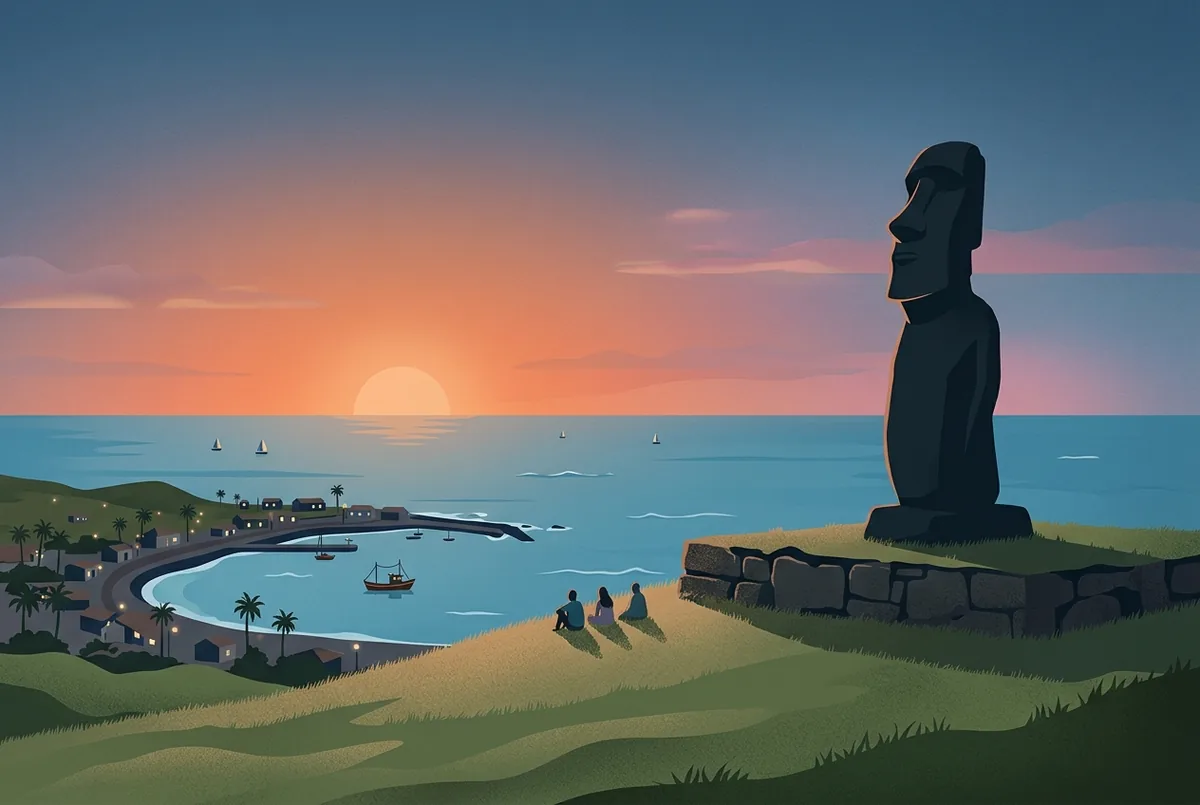
- Day 3: Orongo above the Rano Kau crater, then Tahai for sunset.
- Day 4: a spare day for Ahu Akivi, the town or weather and flight delays.
Travelers report that rain can fall in any month, often in short showers. A team from a Chilean tour operator described sunshine in the morning and heavy rain by the afternoon on a winter trip. Because Rano Raraku and Orongo are one visit each per ticket, put them on a day where you can move the plan around.
Other plans: Chile's tourism board (updated 15-01-2026) proposes two days. Day one covers Ahu Tongariki, Rano Raraku and Anakena, and day two covers Orongo, Ahu Akivi and sunset at Tahai. Wikivoyage says to allow a week to explore thoroughly, and that tours of the main sites usually take two days. A tour seller's five-day plan (Insight Guides, undated) spends one day on caves such as Ana Te Pahu and Ana Kakenga. Our four-night suggestion falls between the two-day and the week-long plans.
Climate: Wikivoyage (undated) describes a humid subtropical climate, usually 12 to 30 degrees Celsius with an average of 20.5. It gives humidity above 80 percent, winds mostly from the northeast and rain spread fairly evenly through the year. Civitatis names September to November and March to May as the best time and says December to February can be hot and more crowded. The sources do not fully agree: our high-season range above runs to March, and the hostel guide prefers April to November, so treat March as a trade-off between crowds and weather.
Tapati festival: Wikivoyage describes a 10-day Tapati festival each February that ends with the election of a queen on the full moon, and advises booking lodging early. A personal blog (January 2026) says it lasts two weeks, with canoe races, a parade and body painting. The length differs by source and we found no official dates, so confirm them before you plan around the festival.
The national park ticket and guide rule
Much of what you will visit is inside Rapa Nui National Park, which is administered by the Ma'u Henua indigenous community. Two rules shape your planning.
- Every visitor needs a ticket, and non-Chileans must select the foreigner ticket. The park warns that choosing the wrong one can stop you at the entrance.
- A guide is mandatory. You must hire a guide accredited by Ma'u Henua. The park site lists the authorized guides, and the guide is paid separately from the ticket. A tour operator's team writes that you have to visit most of the sites with a local guide, and a 2026 travel blog advises a guide at least for Orongo and Rano Raraku. One travel blog lists Tahai and Anakena as guide-required sites yet also calls them freely accessible, so ask which sites need a guide when you book.
| Item | What the sources say |
|---|---|
| Foreign adult price | CLP 95,000 on the checkout page, seen 16-11-2026. Confirm on the official website before paying |
| Foreign child price (ages 7 to 12) | CLP 38,000, reported by a tour-booking page and a 2024 guide. We did not see it at checkout, so confirm it on the official website |
| Validity | 10 consecutive days |
| Who it is for | Adult ticket for ages 13 and over, child ticket for ages 7 to 12 |
| Name on ticket | Personal and non-transferable, shown with passport or ID |
| Refunds | The ticket seller states no cancellations or refunds |
| Rano Raraku and Orongo | One visit each per ticket |
Ticket price, checked 16-11-2026
On 16-11-2026 the checkout page that the park website links to listed the foreigner pass ("Pase Extranjero") at CLP 95,000. The Chilean pass, reserved for Chileans, listed CLP 40,000 for an adult and CLP 20,000 for a child. The park raised its prices on 1 October 2025, and the administrators' announcement, as republished by GoChile, expressed the foreign adult fee as US$100.
We did not see the foreign child price on the checkout page. One guide lists CLP 38,000 and the announcement lists US$40, so confirm it when you buy. Older pages that still show US$80, and one 2026 blog that gives about CLP 42,000, are out of date.
Always confirm the price on the official website before you pay. Prices are set by the Ma'u Henua community and can change without notice. Check rapanuinationalpark.com, which sends you to the official checkout, and read the total in pesos before you complete the purchase. The figures above are a reference from the date shown, not a quote.
Park rules also say no pets, no drones without authorization, and comfortable shoes and clothing. Entry hours change by season. Breaking the rules can mean fines of 5 to 100 UTM.
Buy the ticket before you visit the sites. The park website sends buyers to an online checkout, and travelers also report buying at the airport or at the Hanga Roa office. A tour operator's team recommends downloading the ticket in advance.
What to see around Hanga Roa
| Site | What it is |
|---|---|
| Ahu Tongariki | A long platform with a row of restored moai, popular at sunrise |
| Rano Raraku | The volcanic quarry where moai were carved. One visit per ticket |
| Orongo | A ceremonial village on the rim of the Rano Kau crater. One visit per ticket |
| Anakena | A white-sand beach with moai |
| Tahai | An archaeological complex next to Hanga Roa, popular at sunset |
| Ahu Akivi | An inland platform with seven moai that face the sea |
The park also lists Te Pito Kura, Vinapu, Puna Pau, Akahanga, Vaihu and Ana Te Pahu among its sites. Your guide can help you plan the order around the weather and the light.
A January 2026 blog, which carries affiliate links, adds detail on the Puna Pau quarry, where the red scoria topknots came from. It also lists petroglyphs at Papa Vaka, Orongo and Ana Kai Tangata, and night-sky tours at the Hanga Roa observatory. It puts Ahu Tongariki about a 30-minute drive from town and Ahu Akivi about 20 minutes. For the Ana Kakenga cave it says to bring a flashlight and sturdy shoes, and you should ask your guide whether a cave visit needs a guide or special access. The same blog warns of strong currents and a steep trail at Ovahe beach, so ask locally before you swim.
Where to stay in Hanga Roa
Stay in Hanga Roa. It is the island's main town and has the restaurants, shops and most of the lodging. Wikipedia cites about 2,500 beds in 2022, from camping sites to luxury hotels, so capacity is limited. The one hard rule is accreditation: tourists may only stay at establishments accredited by SERNATUR, so check the official list at serviciosturisticos.sernatur.cl before you pay a deposit. A listing on a booking platform does not prove accreditation. Travelers advise booking far ahead for high season. One 2026 blog puts it as "book everything six months out or you won't find beds."
Food, getting around and what it costs
Plan on spending more than on the mainland. Almost everything reaches the island by air or sea, and recent travel guides describe higher prices at restaurants and shops. The figures below come from guides and trip reports of different dates, so treat them as a range to plan with, not as a quote. Confirm anything you will pay for before you book. For cards, ATM fees and tipping, read our guide to money in Chile.
What to eat in Hanga Roa
Fish and ceviche are the local focus. A December 2025 guide names Tataku Vave (seafront, fish and ceviche), Te Ra'ai (umu cooking, described as pricier than average), Makona (large portions), Hani Hani and Oheho Surf Café. A 2024 guide also mentions Makona for ceviche and a bakery, Panadería Hitu, for cheap empanadas, and calls Te Moana expensive. These are mentions in other people's guides, not our verified recommendations, and places open and close, so check hours and reviews before you go.
- Opening hours: the December 2025 guide says most places open from about 9:00 to 13:00 and again from 16:00 to 20:00, so do not count on a late lunch.
- Cheap meals: a 2026 trip report suggests the fast-food stands near the football field for meals under about US$10 an item, and empanadas and bakeries are the usual budget option.
- Sit-down meals: the same 2026 report puts entrees at about US$20 to US$30, with fish from about US$22 a plate. A separate guide lists restaurant meals at CLP 8,000 to 20,000 per person. Both ranges fit the same picture: expect to pay more than on the mainland.
- Empanadas: reports disagree, from about CLP 1,500 for cheese and ham to CLP 3,000 to 4,000 for a larger one, so the size and the place matter.
How travelers save on food
- Rent a place with a kitchen. Several reports say that cooking most meals and eating out once a day is the main way to cut costs.
- Buy dry goods in Santiago. A 2024 guide says dry products cost about 40 percent less on the mainland, and a 2026 report says packaged goods on the island run 10 to 25 percent higher and fresh items much more. Before you pack fresh food, check the rules of the agricultural service (SAG), which controls what can travel to the island.
- Check the exchange. A 2024 guide advises paying in pesos rather than in dollars, and another recommends carrying some cash in pesos.
Getting around
Chile's tourism board lists walking, renting a vehicle, a motorcycle or a bicycle as ways to get around Hanga Roa. In town that works well. For the park sites you need an accredited guide, so many visitors book a tour or arrange transport with their guide. Travelers say bikes, scooters and quads suit short hops around Hanga Roa but not the longer trips to Anakena or Rano Raraku, and that a quad tops out at about 50 km/h. One travel blog notes that rental vehicles may not be insured, so ask the rental company about insurance and licence rules.
Wikivoyage (undated) gives rental prices in pesos for 8 hours: bicycle 8,000, motor scooter 23,000, small jeep or car 20,000 and larger cars 25,000 to 40,000. It says a taxi within Hanga Roa should not cost more than 1,500 pesos, an undated figure that may be out of date. Those rates are for 8 hours, so they are not directly comparable with the daily figures in the budget table below. The car rate is well below the 2024 daily figure there, which suggests the Wikivoyage prices are old, while its 24-hour bicycle rate of 10,000 is close to the table. Civitatis lists day trips at about US$73 for Rano Raraku, Tongariki and Anakena (7 to 8 hours) and about US$54 for Orongo and Rano Kau (3 hours). The page does not say whether the park ticket is included, so ask the operator.
A realistic budget
The sources do not agree on a daily total, and some leave out flights. A 2024 guide suggests about EUR 40 per person per day without flights, while a 2026 guide says a day on the island at US$100 per person is unlikely and puts a six-night trip at US$1,100 to US$1,350 per person with flights and camping. The table lists the pieces so you can build your own number.
| Cost | What the sources report | Source date |
|---|---|---|
| Round-trip flight from Santiago | Basic fares from about US$350. In 2026 prices of US$750 to US$1,000 or more are common, and one traveler paid US$725. A 2024 guide cites EUR 300 to 450 in low season | 2026, 2024 |
| National park ticket (foreign adult) | CLP 95,000. See the price note above and confirm on the official website | 16-11-2026 |
| Dorm bed in a hostel | US$35 to US$50 per night | 2026 |
| Basic hotel or guesthouse | About US$80 to US$150 per night | 2026 |
| Camping with your own gear | About US$20 per night, or CLP 10,000 per person | 2026, 2024 |
| Food, cooking most meals | About US$12 to US$20 per person per day, or US$25 to US$40 with one meal out | Undated, 2026 site |
| Rental car, per day | CLP 40,000 to 65,000 in 2024. A 2026 report quotes about US$100 for an automatic, plus fuel | 2024, 2026 |
| Bicycle, per day | About CLP 10,000 to 12,000 | 2024, undated |
| Full-day guided tour | About US$60 to US$120 per person, depending on group size and operator | 2026 |
Prices change, and several of these figures come from sources that do not show a date. Use them to compare options, and ask each hotel, rental company and guide for a current quote.
Common mistakes
- Booking a place that is not accredited. The entry form needs an accredited reservation.
- Buying the wrong ticket. Foreign visitors need the foreigner ticket.
- Arriving without a guide. The park requires an accredited guide.
- Counting on a long stay. The limit is 30 consecutive days.
- Flying a drone. It needs authorization inside the park.
- Planning a do-it-yourself moai circuit. Some online guides suggest exploring the sites by car or bike on your own, but the park requires an accredited guide at its sites.
What travelers say
We read recent trip reports and travel guides for patterns. The sources are blogs, a tour operator and travel media, not forums, and they are listed at the end. Treat price and rule details as leads and check them with the park and the government.
- The ticket price is the most confused detail. Two sources from 2025 and 2026 quote US$100 for foreign adults since 1 October 2025, an older travel blog still mentions US$80, and one 2026 blog gives about CLP 42,000. The checkout page showed CLP 95,000 for the foreigner pass on 16-11-2026, and a December 2025 guide also quotes CLP 95,000, so check the price in pesos when you buy.
- Food and lodging take most of the budget. Recent guides agree that meals out cost more than on the mainland and that self-catering is the main way to save. They disagree on totals, from about EUR 40 a day without flights to well over US$100, mostly because of lodging and flights.
- Most park visits involve a guide. A Chilean tour operator's team writes that "you have to visit most of the sites with a local guide," and two other sources say the same without naming each site.
- The single-entry rule shapes your day. Several sources repeat that Rano Raraku and Orongo can be entered once per ticket. One blog adds that a weekday morning in the shoulder season at Rano Raraku was nearly empty.
- Rain and wind are normal. Showers can come in any month, winters are windier and the sun sets early. Travelers recommend a flexible plan.
- Travelers disagree on the guide rule. A June 2026 blog about a late-October trip says Tahai can be seen from the street and that its author hiked Rano Raraku without a guide. A travel blogger who updated her trip report in March 2026 says visitors must enter the park with a guide and toured with one. The park website requires an accredited guide, so follow it, and ask which sites you can see freely.
- Airport and weather details. The June 2026 blog advises carrying a printed park pass, because the airport counter asked for proof of a pre-purchased pass and the terminal had no signal. The March 2026 report says to arrive about two and a half hours early, that an online entry form is required before boarding, and that Rano Raraku had strong wind, intense sun and red clay that turns slick when wet.
- Bikes work for short trips. The June 2026 blog rented a mountain bike for about US$15 a day and rode from Hanga Roa to Ahu Akivi, around 7 miles. The year of the trip is not stated, and this is a single report.
- Rules have tightened. Two blogs say park access and entry rules changed in recent years, and one notes that a campground at Anakena has closed.
Frequently asked questions
Is Hanga Roa an island or a town?
Hanga Roa is a town, not an island. Searches for Hanga Roa island usually mean Easter Island (Rapa Nui), where Hanga Roa is the main town, the harbor and the location of the airport.
How many days can you stay on Easter Island?
Tourists can stay a maximum of 30 consecutive days. Extensions are only possible in cases of force majeure or unforeseen events, and the decision belongs to the provincial government office of Rapa Nui.
Do you need a visa for Easter Island?
Foreign visitors must meet all of Chile's entry rules for foreigners, plus the special Rapa Nui requirements. Whether you need a visa for Chile depends on your nationality, so check that first, then add the Rapa Nui entry form, the return ticket and the lodging reservation.
Do you need a guide to visit Rapa Nui National Park?
Yes. The park states that you must buy a ticket and hire a guide accredited by Ma'u Henua, the Rapa Nui community that administers the park. Guides are hired separately from the ticket. Travelers describe the rule less uniformly for sites near town such as Tahai and Anakena, so confirm with your guide or Ma'u Henua which sites you can visit on your own.
Can you stay in any hotel or rental in Hanga Roa?
No. Tourists may only stay at establishments accredited by SERNATUR, Chile's national tourism service. Check the accreditation before you book, because the online entry form asks you to select your accommodation and submit the reservation.
How long is the national park ticket valid?
The ticket is valid for 10 consecutive days. It is personal and non-transferable, and you show it together with your passport or ID. Rano Raraku and Orongo can each be visited once per ticket. Sources differ on whether the 10 days count from the day you buy it or from your first entry, so check when you buy.
How much does a day on Easter Island cost?
Guides do not agree. A 2024 guide suggests about EUR 40 per person per day without flights, while a 2026 guide says US$100 a day is unlikely and puts a six-night trip at US$1,100 to US$1,350 per person with flights and camping. Lodging, flights and the park ticket (CLP 95,000 for foreign adults on 16-11-2026) move the total most. Confirm current prices before you book.
When is the best time to visit Easter Island?
Civitatis, a tour seller, names September to November and March to May as the best time, and says December to February can be hot and more crowded. Wikivoyage describes a humid subtropical climate with rain spread through the year, so showers are possible in any month. Lodging and flights sell out early in high season, so book as soon as you have your dates. Guides draw the season lines slightly differently, so March is the month where they disagree.
Sources and notes
This guide is informational. Rules, prices and schedules change, so confirm them with the official sources before you travel. Last checked November 2026. For the content added on 23-11-2026 we use only what we could read in full. We read Wikivoyage only in part, and some other travel sites blocked our access. Read how we verify information in our editorial policy.
- Insight Guides: five-day Easter Island trip (tour seller, undated)
- Civitatis: Easter Island tours (tour seller, page undated)
- My Global Viewpoint: things to do in Easter Island (updated 08-01-2026, affiliate links)
- Chile Travel (tourism board): two-day Rapa Nui itinerary (updated 15-01-2026)
- Wikivoyage: Easter Island (undated, read in part on 23-11-2026)
- Government of Chile, Rapa Nui Protegida: online entry
- Government of Chile, Rapa Nui Protegida: frequently asked questions (Spanish)
- Government of Chile: new regulations for visiting and staying
- Rapa Nui National Park, official site (Spanish)
- GoChile: park announces ticket price adjustment
- SERNATUR: tourism services registry
- Chile Travel (tourism board): Hanga Roa, updated 24 November 2025
- Wikipedia: Hanga Roa (population and geography)
- Imagina Rapa Nui: Hanga Roa town sights
- Novo Monde: Easter Island travel guide (trip in 2014, revised August 2024, so parts may be outdated)
- LorenziGo: how to plan an Easter Island trip (2026)
- Cascada Expediciones: team insights on Easter Island (tour operator interview)
- Hostelworld blog: Easter Island guide
- The Gate: Easter Island admission fee increase (16 November 2025)
- Novo Monde: Easter Island budget (revised June 2024, prices may be outdated)
- Living the Dream RTW: how much it costs to visit Easter Island (updated 29 May 2026)
- That Backpacker: visiting Easter Island on a budget (undated)
- Imagina Rapa Nui: money and prices (undated, some figures old)
- Moto World Explorer: guide to visiting Easter Island (29-06-2026; trip in late October, year not stated)
- Never Stop Traveling: Easter Island trip report (updated 31-03-2026)
- The Daily Packers: Hanga Roa travel guide (updated 2 December 2025)
- Going Awesome Places: guide to visiting Easter Island (updated 16 August 2024)