Destinations / Lake District
Pucón, Chile: how to plan your trip
Pucón is Chile's adventure town, set between Lake Villarrica and an active volcano. This guide covers how many days to stay, the volcano climb and its rules, hot springs, hikes and how to get there.
Quick answer
Plan three days in Pucón, plus a spare one for weather. The Villarrica climb may not be open: we could not confirm it, and Sernageomin, the geology service, raised the alert to yellow on 4 September 2026, then moved to a 0 to 5 scale on 28 October. Hot springs and Huerquehue fill the other days.

How many days to stay
Chile's tourism board publishes itineraries of two days, built around hot springs, and three days, built around hiking and hot springs. A tour operator's plan runs five days, with the volcano on day two.
- Three days: the volcano if the route is open, one hot spring and one hike or river day. This is our own suggestion, not a source figure.
- Add one day as a buffer for weather or an alert closure, and have a plan B with hot springs or Huerquehue.
- Five days: add Huerquehue, rafting and the Caburgua springs without rushing.
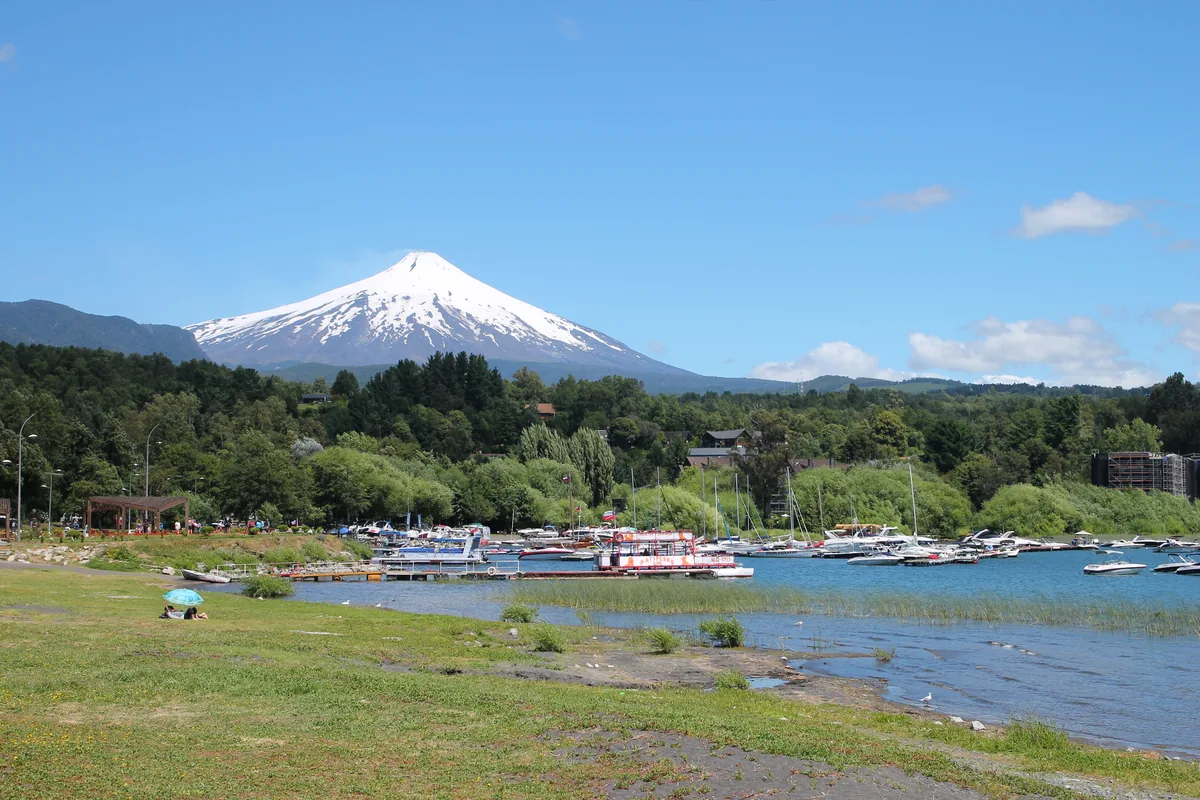
The Villarrica volcano climb
Villarrica rises above the town and is one of Chile's most active volcanoes. Operators describe the climb as non-technical but demanding, and it is the reason many people come. It is also the most uncertain part of a trip, so read this section before you book flights.
Volcano status: the scale changed on 28 October 2026
On 4 September 2026 Sernageomin, Chile's geology and mining service, raised the technical alert for Villarrica from green to yellow, one level above green on its color scale. Emol and Meganoticias reported it on 5 September. Meganoticias says the change did not mean imminent danger for the population and that weather could restrict access to the ski center and the ascents. Senapred, the disaster agency, set a preventive early alert for Villarrica, Pucón and Curarrehue, and Emol adds Panguipulli.
Then the system changed. La Tercera, T13, BioBioChile and Meteored report that from 28 October 2026 Sernageomin replaced the colored technical alerts with a numbered scale of volcanic activity states, from EAV 0 to EAV 5. EAV 0 is the base state, EAV 1 is minor instability, EAV 2 is major instability, and EAV 3 to 5 are minor, moderate and major eruptions. The same reports say Villarrica, which was at the yellow alert, was placed at EAV 1, and that Senapred keeps the power to set territorial alerts. On 17-11-2026 Sernageomin's volcano monitoring site, rnvv.sernageomin.cl, listed Villarrica at "EAV #1", updated on 26 October at 09:45. The site says the new protocol has six levels, from EAV 0 to EAV 5, but it does not define each level, so the meanings above come from the press. It has no news item or technical report on Villarrica, and the only recent reports it lists concern Nevados de Chillán and the Ñuble region. It names no exclusion perimeter for Villarrica, and says Senapred sets the alerts for the population. We found no current closure notice, so the status of the crater route is not verified.
The alert itself, and not only the weather, can close the route. When it reopened in November 2024, reports said the protocol applied while the alert was green and there was no safety perimeter. That protocol was written for the color alerts, and we found no source explaining how it applies to the new numbered scale, so do not assume the route is open because the level looks lower. Before you plan around the climb, check Sernageomin and Senapred, ask CONAF or Pucón's municipality, and get written confirmation from your agency that the route is authorized for your date. If it is closed, do not look for another way up.
The rules
These rules come from an undated ticket page and describe how the climb works when the route is open. They do not mean it is open today.
- Guide: the official ticket page for the ascent says that to climb independently you must carry a FEACH credential. The page does not spell out the abbreviation, and it appears to refer to Chile's mountaineering federation. Without it, or documented experience and full equipment, you can climb only with an accredited agency. Hostelworld and Chile Travel say a guide is required, while Wikivoyage describes an unguided option with CONAF registration, an equipment check and proof of membership in a mountaineering organization, so assume you need an accredited agency. A May 2026 Spanish-language guide adds that agencies should be registered with SERNATUR. For a visitor, that means booking an accredited agency.
- Hours: the same page lists 07:00 to 17:30 in both seasons, with the last entry at 10:00 and changes possible for weather or safety.
- Protocol: the page refers to a municipal ordinance of Pucón and to a protocol of the regional presidential delegation for full conditions. In November 2024, when the route reopened after two years, reports said the protocol applied while the alert was green and there was no safety perimeter. We found no current text.
- Tickets: the park sells national and foreign tickets in separate processes on the ticket site of CONAF, the national forest service. We could not read a price for foreigners.
What the day looks like
Operators describe a day of about 10 hours, for example 6:00 to 16:00. One itinerary starts at 6:30, drives to the ski resort at 1,400 meters, takes the ski lift to 1,800 and then walks 4 to 5 hours to the crater at 2,847 meters, with a return around 17:00. Other sources give 2,861 and 2,840 meters. Guides use crampons and an ice axe when there is snow or ice, and a May 2026 Spanish-language guide lists boots, helmet, layers, water and snacks. Operators say a fitness level is needed even though the route is not technical.
| Item | What the sources report | Source date |
|---|---|---|
| Guided summit climb | CLP 90,000 per person, with 4 to 5 hours of walking | Undated |
| Optional ski lift | CLP 20,000 per person, paid in cash on the day | Undated |
| Minimum age | 18, and not for pregnant women, according to one operator | Undated |
| Panoramic base tour, no summit | CLP 35,000, or CLP 50,000 with the ski lift, June to September | Undated |
These prices come from operator pages with no date, and they may predate the September alert. Confirm what each agency includes, such as the park entrance, equipment and insurance. Wikivoyage, with 2018 prices that are more than 18 months old, gives US$130 to 165 for the guided climb, in a different currency from the CLP 90,000 above, so the two cannot be compared, and says guided tours usually start around 07:00, some at 05:00, and that most guides do not go higher after 14:00. Hostelworld and Chile Travel put the summit at 2,847 meters, while Wikivoyage gives 2,861 in a heading and 2,840 in the text.
Hot springs
Chile's tourism board lists Termas Geométricas, which it describes as 17 pools between 35 and 45 degrees Celsius, about 82 kilometers and nearly two hours from Pucón. It also lists the Los Ríos hot springs at Coñaripe, the Peumayén hot springs near Huerquehue, and Ojos del Caburgua, a set of clear springs and small waterfalls close to town. Other guides name Termas de Huife, with pools beside the Liucura River, and Menetúe.
| Place | What the sources report | Source date |
|---|---|---|
| Termas Geométricas | Entry CLP 44,000 to 48,000 per person in a 2023 trip report. A Brazilian blog gives CLP 20,000 to 24,000. A tour with transport and entry is listed at CLP 62,000 to 75,000 | 2023 and undated |
| Montevivo | CLP 25,000 for adults and CLP 12,000 for children, in three-hour blocks, Wednesday to Sunday | 2023 |
| Menetúe | CLP 25,000 to 35,000, depending on whether lunch is included | 2023 |
| Ojos del Caburgua | CLP 5,000 per person, according to a tour operator | Undated |
The figures for Termas Geométricas disagree by a factor of two, and we found no entry price for Termas de Huife. Check each resort's official website for the current rate and for any foreigner price. Wikivoyage, with prices from 2018 and one from October 2024, all older than 18 months, gives Termas Los Pozones at CLP 15,000 with five natural pools at 35 to 45 degrees and hours of 11:00 to 22:00, Termas San Sebastián at CLP 7,000 and Eco Termas Río Blanca at CLP 5,000, the last per day.
Huerquehue and other hikes
Huerquehue National Park is the usual hiking day. The Los Lagos trail is described as a 12 to 13 kilometer route of at least four to five hours, and Chile's tourism board also lists a two-day, 27-kilometer route called Los Huerquenes. The ticket site lists the park as open Tuesday to Sunday from 08:30 to 17:30, with the last entry at 14:00.
- Trail closures: the ticket page says the San Sebastián and Quinchol trails are closed from 8 June to 15 December, without showing a year, and that the park is open only on the Los Lagos trail until further notice. If that closure repeats every year, it covers today's date, so the two-day Los Huerquenes route may not be available.
- Villarrica National Park: the ticket page for its northern sector says the trail to the Pichillancahue glacier is closed to the public from 28 July to 31 December, also without a year.
- Tickets: Huerquehue sells tickets on the same ticket site. We could not read a foreigner price. Wikivoyage, undated and with many prices from 2018, gives CLP 7,000 and hours of 09:00 to 15:00, which conflicts with the ticket site's 08:30 to 17:30, so use the ticket site. It also lists Quetrupillán, with a CONAF registration and a fee of CLP 5,000, date not given.
Rafting and water activities
The Trancura River is the center of rafting. A Spanish-language guide describes the lower Trancura as class II to III and the upper as class IV to V, and a trip report calls the Turbio River class III with optional class IV. Sources differ on the class of each route, so ask the operator which section you will run, and what the minimum age is.
A January 2023 trip report gives these prices: rafting CLP 25,000 to 40,000, kayaking about CLP 20,000, a five-hour canyoneering tour CLP 35,000, a sunset boat ride on the lake CLP 5,000 and entry to the El Claro waterfall CLP 2,000. They are 2023 prices, so expect different numbers today. Wikivoyage, with 2018 prices more than 18 months old and in US dollars, unlike the CLP prices above, gives US$38 to 46 for rafting on the upper Trancura and US$46 for canyoning, and the Kayak travel site describes third- and fourth-level rapids, which does not match the classes above exactly.
Getting there and when to go
- By air: Chile's tourism board gives the Santiago flight as 75 minutes to La Araucanía Airport, in Freire, near Temuco. From there Pucón is about 100 kilometers, roughly one and a half hours by Route 199. Transfers and rental cars are available at the terminal.
- By bus: the tourism board puts Santiago at 780 kilometers by Route 5 South, about 10 hours. A 2023 trip report quotes US$31 to 36 for the bus, and an undated guide gives intercity buses at CLP 8,000 to 18,000 without naming a route, so the two figures are not comparable.
- Season: the board says the town works all year and suggests low seasons to avoid crowds. January and February are the busiest months, and one guide advises booking lodging at least three months ahead for January, February or July. Another says winter brings closures.
Our guide to money in Chile explains cards and ATMs. If you are going north next, see our guide to San Pedro de Atacama.
More practical details
- Bus times and fares: Hostelworld says around 10 hours overnight from Santiago and the Kayak travel site, undated, prints 11 hours and CLP$20,900, which we read as CLP 20,900. Wikivoyage, with 2018 data more than 18 months old, gives Turbus at 11 hours 30 minutes and Jac at 9 hours 23 minutes, at 11,500 to 21,700 pesos, so the fares and times differ by source. Kayak and Wikivoyage both say about eight hours by car with seven tolls, at 1,600 pesos each in the 2018 Wikivoyage data.
- Local transport: The Kayak travel site, undated, gives taxi rides from CLP 1,500, the lowest listed car rental rate at CLP 10,000 a day and a 20-minute minibus to Villarrica town, and Wikivoyage, with 2018 data more than 18 months old, gives 800 pesos for buses to Caburgua. Kayak says trains to Temuco have been suspended, while Wikivoyage, with its 2018 data, says they run in summer, so we do not rely on a train.
- Food: Hostelworld names cazuela, merkén, lake trout, kuchen, craft beer, sopaipillas and catuto. Wikivoyage, with 2018 data more than 18 months old, names Ecole, vegetarian, and La Maga, a barbecue place, and says to book ahead in summer without tying that to one restaurant, and Kayak, undated, puts dinner for two at La Maga at CLP$20,000, as printed.
- Practical: Hostelworld gives 133 for the police and 131 for an ambulance, safe tap water and a 10% tip, and says January and February are the busiest months while Kayak names December and February as the peak, so the sources differ.
Where to stay and what activities cost
Hostelworld names three areas, the town center around Avenida O'Higgins, the lakeshore at Playa Grande and La Poza, and the road to Caburgua with cabins and hostels, and Wikivoyage, with 2018 data, names the center, the peninsula near the golf course and the lakeshore. Hostelworld, undated, gives dorms at around 12 to 22 euros, as printed, which is not comparable with the dollar averages below. We found no advice on noise, and the booking-site snapshot that HotelsCombined updated on 17 November 2026 is the only aggregate price list we have. It shows an average of about $41 a night for a hostel and $43 for a hotel, with the currency written only as a dollar sign, and the lowest price found at $10. Its own examples are much higher than those averages: Lucky's Hostel at about $72, Maki Hotel at $110, Mirador Los Volcanes at $95 and Hotel Antumalal at $263. The figures do not fit together, so use them only as a rough range.
- Season: the same page says October is the cheapest month and February the most expensive, although its FAQ names a different month, so treat that as unreliable. A May 2026 Spanish-language guide advises booking at least three months ahead for January, February or July.
- Location: we have no source on noise or on which streets suit light sleepers, so check recent reviews for each place.
The main paid activities cost as follows, from undated operator pages or a 2023 report: the guided volcano climb at CLP 90,000 plus CLP 20,000 for the optional ski lift, if the route is open, rafting at CLP 25,000 to 40,000, and a hot spring at CLP 20,000 to 48,000 before transport. Add meals and your lodging.
Sample hotel prices in Pucón (Booking.com, 17-11-2026)
We searched Booking.com on 17-11-2026 at 21:09 for one night, 28 to 29 November 2026, two adults, with the currency set to CLP. Most cards show taxes and fees as a separate amount, shown here after the plus sign. "Not listed" means the card did not mention breakfast, which does not confirm it is excluded. Each row is the first result of a filter, not a recommendation: low is the first result rated 8.0 or higher sorted by lowest price, mid the first 3★, and high the first 5★, or 4★ where no 5★ appeared. Booking's guest score is in brackets.
| Level | Lodging (Booking score) | CLP per night | Breakfast |
|---|---|---|---|
| Low | Hostal Monica, double with shared bathroom (9.1) | 25,901 + 4,921 | Not listed |
| Mid | Hotel Cumbres del Sur, 3★ (7.9) | 72,403 + 13,757 | Yes |
| High | Hotel Enjoy Pucón, 5★ (7.7) | 174,073 + 33,074 | Yes |
Hotel Cumbres del Sur was CLP 86,031 + 16,346 for 16 to 17 January 2027 (21:12), with breakfast. Prices move with dates and availability, so treat this as a snapshot.
What travelers say
We found one first-person trip report we could read, from January 2023, and no recent forum reports, so treat the details as leads.
- A canyoneering tour was booked on the day. The January 2023 report says its authors spent more than a month in town, booked canyoneering on the day and praised their operator. They note that guides supplied hot tea during the cold sections. This is one report from three years ago.
- The summer crowd is real. The same report advises booking a couple of days ahead in January and February.
- Clouds can hide the volcano for days. An undated climb account on The Outbound, from the high season, says the first three days in Pucón were cloudy and rainy with the volcano hidden, and that the climb happened after the clouds cleared. The group of 11 had four guides, met at an agency at 6:00 and spent about four hours climbing with a rest every 45 minutes. It lists the tour at CLP 80,000 and the optional ski lift at CLP 10,000, which differ from the undated prices in our table.
- The climb is strenuous and the operators are many. A Komoot comment of 15 March 2025 describes a group of 11 with four guides leaving at 6:00, calls the climb very strenuous, notes fresh snow on the rim and says the number of tour operators was overwhelming. Both accounts predate the September 2026 alert, so they say nothing about the current status of the route.
Frequently asked questions
Can you climb the Villarrica volcano right now?
Only if the authorities say the route is open, and we could not confirm that. Sernageomin raised the volcano's technical alert from green to yellow on 4 September 2026. Since 28 October it uses a 0 to 5 scale, and its monitoring site listed Villarrica at EAV 1 on 17-11-2026, updated 26 October, with no technical report or exclusion perimeter for this volcano. The 2024 reopening protocol applied while the alert was green, and we found no source on how it applies now. Check Sernageomin, Senapred and CONAF, and get written confirmation from your agency.
Do you need a guide to climb Villarrica?
Practically yes. The official ticket page for the ascent says that to climb on your own you must carry a FEACH mountaineering credential. Without it, or documented experience and full equipment, you can only climb with an accredited agency.
How long does the Villarrica climb take?
Operators describe a day of about 10 hours, such as 6:00 to 16:00, with 4 to 5 hours of walking up on snow and volcanic ash. One itinerary uses a ski lift to 1,800 meters and reaches the crater at 2,847 meters. Other sources give 2,861 and 2,840.
How many days do you need in Pucón?
Chile's tourism board suggests itineraries of two and three days, and one tour operator uses five. Three days fit the volcano, a hot spring and one hike if the weather cooperates. Add a spare day for the volcano, because weather can postpone it.
How do you get to Pucón from Santiago?
By bus, which takes about 10 hours over roughly 780 kilometers, or by a flight of about 75 minutes to La Araucanía Airport near Temuco, followed by a drive of about 100 kilometers and one and a half hours.
Which hot springs are near Pucón?
Chile's tourism board lists Termas Geométricas, with 17 pools between 35 and 45 degrees Celsius, the Los Ríos springs at Coñaripe and Ojos del Caburgua, a set of clear springs and small waterfalls. Entry prices differ widely between sources, so check each one before you go.
Sources and notes
This guide is informational. Volcano alerts, prices, hours and rules change, so confirm them with the official sources before you travel. Last checked November 2026. On 23-11-2026 we read Hostelworld, Kayak, Wikivoyage and Chile Travel, and could not read Culture Trip, Audley Travel or Sygic, which failed. Wikivoyage prices marked 2018 are more than eight years old, so treat them as historic, not as current. Read how we verify information in our editorial policy.
- Chile Travel: Villarrica volcano (updated 24-11-2025)
- Wikivoyage: Pucón (undated, prices from 2018, one from October 2024)
- Kayak: Pucón travel guide (undated)
- Hostelworld blog: Pucón (undated)
- Sernageomin: Villarrica volcano monitoring page (consulted 17-11-2026, Spanish)
- Sernageomin: volcanic activity states, EAV listing (consulted 17-11-2026, Spanish)
- Sernageomin: new EAV protocol with Senapred (26-10-2026, Spanish)
- Emol: Sernageomin raises the volcanic technical alert (05-09-2026, Spanish)
- Meganoticias: Villarrica increases activity (05-09-2026, Spanish)
- Pase Parques (CONAF ticket site): Villarrica volcano ascent (undated, Spanish)
- Pase Parques: Huerquehue National Park (undated, Spanish)
- Pase Parques: Villarrica National Park, north sector (undated, Spanish)
- Cooperativa: the ascent route reopens after two years (18-11-2024, Spanish)
- Chile Travel (tourism board): Pucón outdoors, hiking and hot springs (updated 02-01-2026)
- Chile Travel: Pucón hot springs, two days (updated 15-01-2026)
- Calendario Chile: what to do in Pucón (03-05-2026, Spanish)
- The Outbound: five days in Pucón (10-01-2023)
- Swoop Patagonia: Pucón five-day trip (operator page, undated)
- TravelDojo: Pucón travel guide (undated)
- Nómades: Villarrica volcano climb (operator page, undated)
- Booking.com: search results for hotel prices (consulted 17-11-2026, Spanish interface)