Food & culture / Language
Chilean Spanish: slang and phrases for travelers
Chileans speak fast, swallow the end of their words and use slang that other Spanish speakers do not always understand. This guide covers the words you will hear every day, the one to use with care and where the sources disagree.
Quick answer
Chilean Spanish is fast, softens the final s and has its own slang, but standard Spanish still works, and a 2023 study-abroad blog says the ear adjusts in a few days. The words you will hear most are cachai (you know?), po (a filler), al tiro (right away), bacán (great) and luca (CLP 1,000).
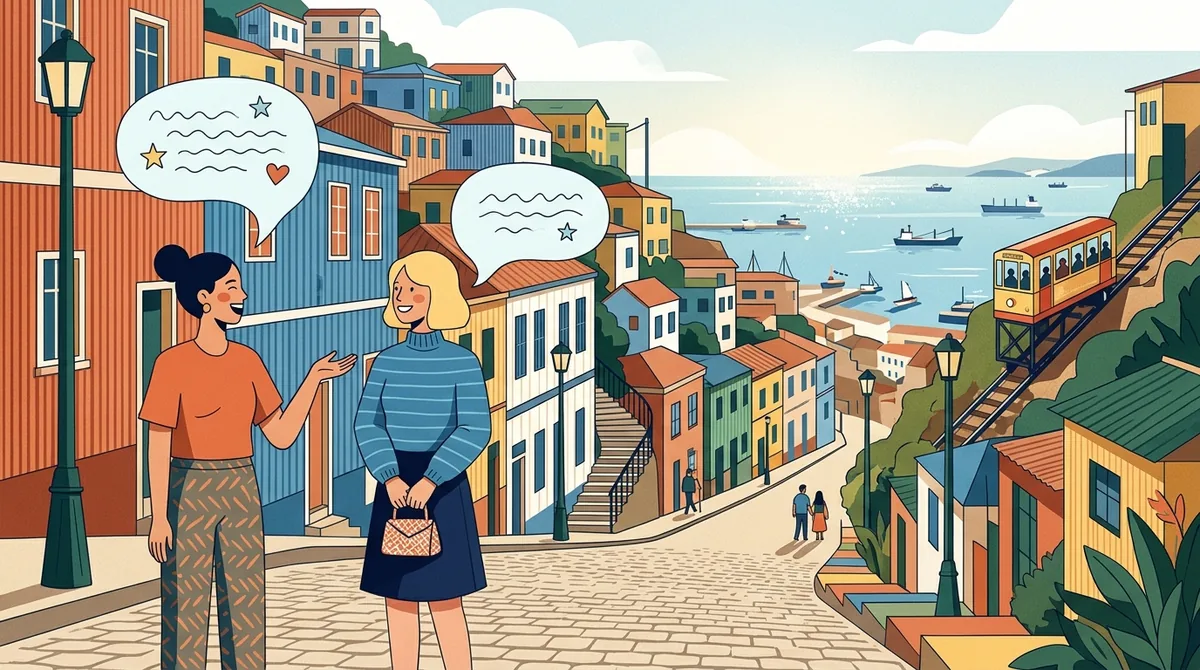
Is Chilean Spanish hard to understand?
Often, at first. Guides point to three things: speed, a final s that is aspirated or dropped, and a large stock of local words. A language guide gives examples of the dropped sounds, with pescado said as pescao and helado as elao, and notes that plurals lose their final s. A study-abroad blog from April 2023 says the speed and the lack of careful pronunciation make Chilean Spanish hard to grasp at first, and that the ear adapts after a few days.
The Chilean Academy of the Language explains why some words sound unfamiliar. Its dictionary of Chilean usage, the DUECh, is a differential dictionary: it lists words used in Chile that do not belong to general Spanish, such as guata, lesear, altiro and fome, and not common words like casa or dormir. The Academy says it describes real usage and does not judge which words are correct. It draws on a text collection from 1950 onward and gives about 9,500 quotations.
- Ask for a repeat. Asking someone to say it again, more slowly, is normal and polite.
- Do not assume English. A travel guide advises asking before you assume that someone speaks English.
- Standard Spanish works. The slang below is optional. Locals will understand you if you use classroom Spanish.
The words you will hear every day
We kept the words that at least three of the guides we read list with the same meaning. Marca Chile, the country brand, includes several of them in its list of expressions every visitor should know.
| Word | Meaning | How it is used |
|---|---|---|
| Cachai? | You know? Do you get it? | Added at the end of a sentence to check understanding |
| Po / poh | No literal meaning | Filler that adds emphasis: sí, po; no, po; ya, po |
| Al tiro | Right away | "Voy al tiro" means I am coming right now. One guide says in practice it can mean soon |
| Bacán | Great, cool | A positive, everyday word. Filete is a less common synonym |
| Fome | Boring | For a dull movie, party or person. The opposite of bacán |
| Pololo / polola | Boyfriend / girlfriend | Pololear means to be in a relationship |
| Carrete | A party | Carretear means to go out partying |
| Buena onda | Good vibes, a nice person | Mala onda is the opposite |
| Caleta | A lot | "Me gusta caleta" means I like it a lot. Harto means the same |
| Pega | Job, work | "Me voy a la pega" means I am going to work |
| La micro | City bus | One guide also uses it for the metro |
| Taco | Traffic jam | Not the food |
| Caña | Hangover | "Tener caña" means to have a hangover |
| Lata / qué lata | Boring, lame | "Qué lata" is closer to a bummer, according to Glossika |
Once is not slang, but you will hear it often. It is an early evening meal of tea and bread, and one guide notes it sometimes replaces dinner. Read more in our guide to Chilean food.
Money and daily life
Prices are often spoken in lucas. A luca is CLP 1,000, so cinco lucas is CLP 5,000 and veinte lucas is CLP 20,000. At the dollar rates quoted in 2026 (CLP 911.77 on 10-08-2026 and CLP 967.79 on 07-10-2026), one luca is about US$1.03 to US$1.10. One guide also lists gamba for CLP 100, but we found it in only one source.
- Andar pato: to be out of money. Marca Chile gives the example that you cannot go out because you are "pato" this month.
- Plata: money.
- Yo me rajo: I will pay, in one guide. Check the context before you accept.
For how to pay, tip and get cash, read our guide to money in Chile.
Weón: the word to use with care
Weón (also written huevón) is in almost every list. Marca Chile says it can mean friend, guy or fool depending on context and tone. Other guides translate it as buddy or dude among friends and as idiot or imbecile in another tone, and two of them warn you to listen to the tone before you use it.
- Understand it, but do not use it yourself. This is our advice, not a rule from a guide: you will hear it often among friends, and a visitor cannot judge the tone as a native speaker does.
- Use standard Spanish in formal settings. A language guide advises it in interviews, business and with older people.
- La raja is a compliment. One guide says it literally refers to a rude body part but means fantastic, especially between friends, so do not read the literal meaning.
Formal and informal speech
A language site notes that Chileans change the ending of tú verb forms: tú hablas becomes tú hablai, tú sabes becomes tú sabí and tú quieres becomes tú querí. You do not need to copy this, but it helps to recognize it when you hear it. Basic courtesy words such as hola, por favor, gracias and de nada work everywhere.
Three more guides, all older than 18 months (italki, 26-05-2017, Australis, 30-05-2019, and Glossika, 31-03-2022), say the same about the verb endings: ¿cómo estai? instead of ¿cómo estás?, and a final s that is dropped. They disagree on one point. Glossika describes the ending as coming from voseo, the vos form, while italki says Chileans use tú, that "voh" is usually unkind and that you should not use it. Australis adds that Chileans say ustedes, not vosotros, for the plural you. As a visitor, you can follow the form the other person uses with you.
Most guides do not cover when to use tú or usted, so we cannot give a rule here. A safe approach is to follow the form the other person uses with you and to use standard Spanish in formal settings.
More words, with fewer sources
These words appear in only one or two of the guides we read, so treat the meanings as less certain. Glossika (31-03-2022), Australis (30-05-2019) and italki (26-05-2017) are older than 18 months, SpanishDict is undated and Spanish.cl was updated on 16-11-2026.
| Word | Meaning | Source |
|---|---|---|
| Flaite | Sketchy, used for dark alleys or shady-looking people | SpanishDict |
| Piola | Chill, calm. Glossika says it means something different in Argentina and Uruguay and is used mostly by people under 40 | Glossika |
| Yapa | A freebie or bonus, used at markets | Glossika |
| Chela | Beer | Glossika, Spanish.cl |
| Piscola | Pisco with cola | Spanish.cl |
| Curado | Drunk | Australis |
| Pasarlo chancho | To have a good time, said by Glossika to be used mostly by people in their thirties and older | Glossika, Australis |
| Cuático / brígido | Shocking or scandalous, said by Glossika to be used mostly by people under 30 | Glossika |
| Tranqui | Calm, do not worry | Spanish.cl |
| Filo | It does not matter | Spanish.cl |
| Copucha | A piece of gossip | Spanish.cl |
| ¿Te tinca? | Do you think so? Asks for an opinion | SpanishDict |
| Tomar once | To have once, the afternoon meal | Glossika |
Glossika, written by a Chilean Spanish teacher, ties some words to age: cachai is mostly used by people under 40, al toque, a variant of al tiro, mostly by teenagers, and qué lata by people in their twenties or older. It is one source and more than 18 months old, so use it as a hint, not as a rule.
Words the sources disagree on
Slang changes by region, age and social group, and the guides do not always agree. When sources differ, we list both meanings. Some of these differences are about context rather than error: ya po changes with tone, pololo and novio differ in how serious the relationship is, and taco has more than one sense.
| Word | What the sources say |
|---|---|
| Mina | One guide says an attractive person of any gender, another says only a young woman. A BBC Mundo note on regional vocabulary describes it as a woman, generally young, in Chile and Argentina |
| Cuico | One guide says rich, another says upper class and, as an adjective, preppy or stuck-up. A collaborative dictionary marks the Chilean sense as informal and pejorative, so avoid calling someone it |
| Copete | One guide says any alcoholic drink, two others say a cocktail or mixed drink |
| Ya po | One guide says come on, two others say yes or okay |
| Pololo | Most guides say boyfriend, and three guides say novio is for more serious relationships or fiancés |
| Taco | Most guides say traffic jam, one adds that it can also mean a heel |
| Huevón | Glossika (2022) says man, dude, idiot or prick and that it borders on rude. italki (2017) says dude or friend, and an insult in an aggressive tone. Australis (2019) says ok, good or hi, friendly or rude by context. Spanish.cl says it has a thousand meanings. Hence our advice to understand it and not use it |
| Novio / novia | Glossika and SpanishDict say a fiancé or fiancée. italki says groom and bride. Two of the guides we read for this update say it is more serious than pololo |
| Cacho | Spanish.cl says a problem or a difficult person. Glossika uses "no cacho" for I do not get it |
A few other words, such as pituto, achacarse and gorrear, appear in only one guide, and we left them out. If you hear a word that is not here, ask what it means.
What travelers say
We read recent guides and a study-abroad blog for patterns, listed at the end. We could not read forum threads, and one popular guide blocked automated access, so these are patterns from guides, not individual traveler reports.
- The accent takes a few days. A 2023 study-abroad blog says the ear adapts after a few days, so a short stay is enough to start following conversations.
- Start with the safe words. A December 2025 language guide suggests starting with bacán, fome and buena onda, and listening before speaking.
- Keep the slang local. One guide warns that these words are not understood in other Spanish-speaking countries, so use them only in Chile.
- Tone decides the meaning. The guides that cover weón agree that the tone decides whether it is friendly or insulting.
Frequently asked questions
What does cachai mean in Chilean Spanish?
Cachai is a casual way to check that the other person understands, like "you know?" or "get it?". Chileans often add it at the end of a sentence. Tourism and language guides agree on this meaning.
What does po mean?
Po (also written poh) has no literal meaning. It is a filler that adds emphasis, as in sí, po (yes, of course) or no, po. One language site says it comes from pues, and another says ya po can mean come on, while two others read it as okay.
Is weón offensive?
It can be friendly or insulting depending on tone and context. Guides translate it as buddy or guy among friends and as idiot in another tone. As a visitor, our advice is to understand it but not to use it yourself. You will hear it between friends, and the same word can insult a stranger, an older person or someone in a formal setting.
How much is a luca?
A luca is CLP 1,000, so cinco lucas is CLP 5,000. Prices are often spoken this way. At the 2026 dollar rates (CLP 911.77 on 10-08-2026 and CLP 967.79 on 07-10-2026), one luca is about US$1.03 to US$1.10.
Is Chilean Spanish hard to understand?
It is known for speed and for aspirating or dropping the final s of words, and it has a lot of local slang. A study-abroad blog from 2023 says the ear adapts after a few days. Standard Spanish still works, and asking someone to repeat more slowly is normal.
What does pololo mean?
Pololo (male) and polola (female) mean boyfriend or girlfriend, and pololear means to be in a relationship. Some guides say novio and novia are reserved for more serious, committed relationships or fiancés, while others treat the words as simple equivalents.
What does al tiro mean?
Right away. SpanishDict says to reserve it for things that are about to happen right now, and Glossika (2022, older than 18 months) says al toque is a variant used mostly by teenagers. An earlier guide we read says that in practice al tiro can mean soon, so allow some slack.
Do Chileans use vos or tú?
Sources disagree. Glossika (2022, older than 18 months) describes the -ai endings, as in ¿cómo estai?, as coming from the vos form, while italki (2017, older than 18 months) says Chileans use tú and that voh is usually unkind. You can follow the form the other person uses with you.
Sources and notes
This guide is informational. Slang changes by place and by speaker, so treat the meanings as approximate. Last checked November 2026. On 24-11-2026 we could not read Say Hueque (access denied) or Culture Trip (timed out), so nothing is taken from them. Read how we verify information in our editorial policy.
- Australis: 15 Chilean slang words (30-05-2019, older than 18 months)
- italki: words and expressions you will need in Chile (26-05-2017, older than 18 months)
- Glossika: Chilean slang (31-03-2022, older than 18 months)
- Spanish.cl: Chilean Spanish dictionary (updated 16-11-2026)
- SpanishDict: how to sound like a local in Chile (undated)
- Marca Chile: 10 expressions every visitor should know (20-11-2025)
- Academia Chilena de la Lengua: the DUECh, dictionary of Chilean usage (Spanish)
- South America Travel: languages of Chile, Spanish, slang and useful phrases (undated)
- Lingopie: 20 Chilean slang words (updated 09-12-2025)
- FluentU: 29 Chilean slang words (modified 21-11-2024, older than 18 months)
- Spanish Academy: your ultimate guide to Chilean slang (06-05-2021, older than 18 months)
- Cascada Expediciones: A to Z guide to Chilean Spanish (undated)
- Postcards from the World: a guide to Chilean slang (about 2015, so some words may be dated)
- CIEE: Chilean Spanish (12-04-2023, older than 18 months)