Food & culture / Eating in Chile
Chilean food: what to eat and what it costs
Chilean food changes from the desert in the north to the islands in the south. This guide covers the dishes worth trying, how mealtimes work, the drinks, and what you should expect to pay, with the 2026 figures we could confirm.
Quick answer
Chilean food centers on empanadas de pino, pastel de choclo, cazuela, completos and seafood, with curanto in Chiloé. Lunch is the main meal, and the menú del día, a fixed-price set, costs about CLP 6,000 to 9,000 in Santiago, according to a May 2026 guide. A 10 percent tip is suggested and voluntary.
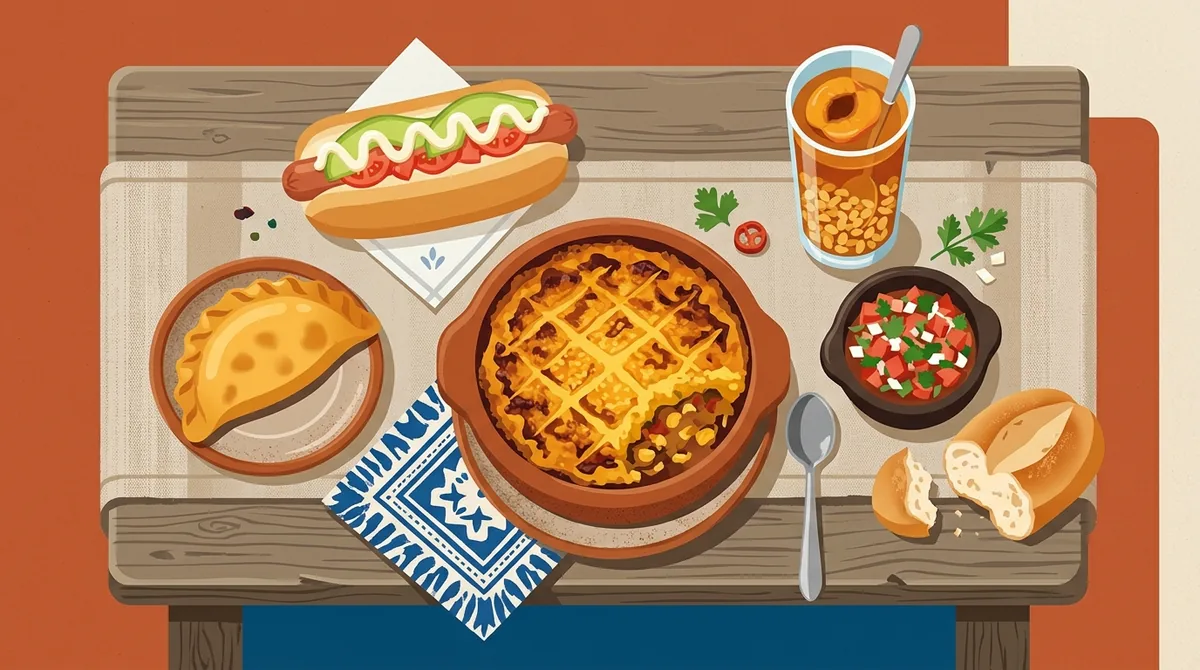
Chilean food by region
Chile's tourism board organizes the cuisine by region. We list the dishes it names and the price bands it gives, which it published in November 2025 as estimates in Chilean pesos.
| Region | Dishes the tourism board names | Its price estimate |
|---|---|---|
| North | Andean heritage: chairo (a soup of meat, potatoes and corn), calapurca (a soup cooked with hot stones), roast alpaca, corvina ceviche in Arica and Iquique | Main courses CLP 12,000 to 20,000 |
| Center | Creole tradition: asado, empanada de pino, pastel de choclo, humitas in summer, cazuela de ave, caldillo de congrio. It recommends the picadas of Santiago and the Mercado Central | Popular dishes and drinks CLP 5,000 to 15,000 |
| South | Seafood and Patagonian cooking: salmon, trout, lamb, wild mushrooms. In Chiloé, curanto cooked in a pit on hot stones. In Patagonia, lamb roasted on a spit and creamy king crab stew | Dishes CLP 10,000 to 25,000 |
| Rapa Nui | Polynesian heritage: umu ta'o (the island's curanto cooked with volcanic stones), tuna steak on a hot stone, po'e (a sweet banana or pumpkin cake) | Dishes CLP 25,000 to 50,000 or more, because of the island's logistics |
If you are going to the island, see our Hanga Roa and Easter Island guide for what to budget there.
The government's catalogue of Chilean dishes
The Undersecretariat of Tourism published a catalogue of Chilean cuisine in 2024. It divides the country into five zones, with the typical ingredients and the traditional preparations of each, and notes that the culinary borders are blurred.
- North: seafood such as machas, locos and sea urchins; quinoa, llama and alpaca; olives from Azapa. Preparations include chupe de locos, pejerreyes, sopaipillas with pebre and fried llama empanadas.
- Center: grapes, corn, beans and fresh herbs. Preparations include empanadas de pino, pastel de choclo, carne mechada, leche asada and mote con huesillo.
- South: salmon, hake, conger eel, mussels, razor clams, lamb, dairy and berries. Preparations include machas a la parmesana, pulmay, pastel de papas, kuchen and picarones.
- Patagonia and Antarctica: king crab (centolla), lamb, wild mushrooms and calafate berries. Preparations include chupe de centolla, lamb roasted on a spit, roast Magellanic lamb leg and fried Croatian pastries.
- Islands: in Rapa Nui, tuna, sweet potato, po'e and tunu ahi; in Chiloé, more than 200 varieties of potato, milcaos, chapaleles and curanto in a pit; in Juan Fernández, lobster and golden crab.
Dishes to try first
These are the dishes guides describe most often. The descriptions follow a June 2026 guide to Chilean food, unless noted.
- Empanada de pino: a baked or fried pastry filled with minced beef, onion, a hard-boiled egg, an olive and a raisin.
- Pastel de choclo: a corn pie baked in a clay dish. Recipes differ on whether they include raisins or chicken.
- Cazuela: a clear stew of beef or chicken with a potato, a piece of squash and corn on the cob.
- Humitas: seasoned ground corn wrapped in corn husks and steamed.
- Completo italiano: a loaded hot dog, usually with avocado, tomato and mayonnaise. The classic version contains a sausage.
- Sopaipillas: fried discs of pumpkin dough, sold at stands for CLP 500 to 1,000 each, according to a May 2026 guide.
- Seafood: caldillo de congrio (conger eel soup), machas a la parmesana (razor clams with cheese), fried fish with potatoes, pastel de jaiba (crab pie) and locos with mayonnaise.
- Curanto: from Chiloé, layered shellfish, meat and potatoes cooked on hot stones. A May 2026 guide lists it at CLP 15,000 to 25,000 per person.
- Sweets: manjar (a milk caramel) and alfajores, cookies filled with it. Nomad Paradise (updated 24-07-2024, older than 18 months) adds kuchen, a fruit pie of German origin that is most often made with apple, and brazo de reina, a roll cake sold in any bakery.
- Chorrillana: a shared plate of fries topped with fried onions, fried eggs and minced beef or sausage. Tasting Table (updated 08-09-2025) gives its origin as Valparaíso. Eat Your World (03-07-2024, older than 18 months) says a serving for two can feed four and gives 13 August as its national day.
- Sandwiches: Tasting Table describes the churrasco as a steak sandwich, with the barros luco (with cheese) and the chacarero (with tomato and green beans) as variants. Nomad Paradise (24-07-2024, older than 18 months) lists the completo in an Italiano version (avocado, tomato, mayonnaise), an alemán (tomato, mayonnaise, sauerkraut) and a chacarero.
- Charquicán: Tasting Table describes a dish of ground or shredded beef with potatoes, beans, peas and corn, topped with a fried egg. It adds that it was originally made with dried llama or horse meat.
- More from the sea and the stock pot: Tasting Table names paila marina, a clay bowl of clams, mussels, shrimp and fish served at the Mercado Central in Santiago, and valdiviano, a dish from Valdivia made of dried meat in broth with vegetables and boiled eggs.
Flavors and influences. Wikipedia (undated, read in part) says the cuisine blends Spanish cooking and Mapuche culture with local ingredients and with German, British and French influences. Eat Your World (03-07-2024, older than 18 months) says Chilean food is generally not spicy, and that ají is available on request. Insight Guides (22-08-2019, older than 18 months) said merkén, a smoked chili seasoning of Mapuche origin, had come onto menus.
Mealtimes, bread and once
A June 2026 expat guide gives the usual rhythm: lunch between about 1:30 and 2:30 pm, once between 5 and 8 pm, and dinner rarely before 8:30 pm. A May 2026 article adds that many Chileans rely on once instead of dinner, and that many local restaurants open only for lunch. If you want a sit-down meal in the evening, check the opening hours first.
- Once: a spread of bread, avocado, cheese, ham, jam and tea.
- Bread: the staple is the marraqueta, with amasado and hallulla as other common rolls. Tasting Table (08-09-2025) cites a 2019 USDA report (older than 18 months) that places Chile second in the world for bread consumption, about 200 pounds (90 kg) a person a year. It also says pan amasado is usually served with pebre when you sit down in a local restaurant. Pebre is a sauce of tomato, cilantro, onion, chili and garlic.
- Coffee: the same expat guide says tea matters more than coffee in Chile. Insight Guides (updated 22-08-2019, older than 18 months) says coffee is almost always instant. It also says lunch runs from about 1:30 to 4 pm and once from 5 to 7 pm, windows that differ from the 2026 guide, so confirm the hours at the restaurant.
Drinks
Pisco, a grape spirit, is behind the two best-known cocktails: the pisco sour and the piscola, which mixes pisco with cola. The terremoto, a glass of sweet pipeño wine with pineapple ice cream, appears on menus around the national holidays in September, according to a May 2026 article. The mote con huesillo is a cold drink of husked wheat and a dried peach, sold at stands such as those on Cerro San Cristóbal in Santiago.
- Wine: the government catalogue names Cabernet Sauvignon, Carmenère, Syrah, Chardonnay and Sauvignon Blanc as the main grapes of the central valleys. In the north it lists sweet wines such as Pajarete and Pintatani and Chilean pisco, and in the south craft beer and cider.
- Beer: local brands named in a May 2026 guide include Kunstmann (Valdivia), Austral (Patagonia), D'Olbek (made with maqui) and Guayacán (papaya).
- Public drinking: the same guide says drinking alcohol in public spaces such as parks and beaches is prohibited. We did not confirm that against a legal text, so check the local rule before you open a bottle outdoors.
- Age: a travel guide gives 18 as the minimum drinking age. Carry ID.
What it costs
Prices vary by city, neighborhood and restaurant, and the guides we read do not always agree. The table gives the 2026 ranges with each source. As a rule of thumb for the conversion, CLP 1,000 is about US$1.03 to US$1.10 at the 2026 dollar rates (CLP 967.79 on 07-10-2026 and CLP 911.77 on 10-08-2026).
| Item | What the sources report | Source date |
|---|---|---|
| Menú del día (Santiago, Valparaíso, Temuco) | CLP 6,000 to 9,000 | 14-05-2026 |
| Menú del día (tourist areas) | CLP 8,500 to 18,000 | 01-2026 |
| Menú del día (Viña del Mar, weekdays until 15:00) | CLP 9,900 at one restaurant | 10-01-2026 |
| Empanada | CLP 1,500 to 2,500, and about CLP 2,500 in another guide | 05-2026, 01-2026 |
| Completo from a street stand | CLP 1,500 to 3,000, and about CLP 4,200 on average at chains | 05-2026, 01-2026 |
| Pastel de choclo or cazuela at a picada | CLP 6,000 to 10,000 | 14-05-2026 |
| Mid-range seafood plate | CLP 10,000 to 18,000 | 14-05-2026 |
| Market meal (La Vega, Mercado Central) | CLP 5,000 to 8,000 | 14-05-2026 |
| Mote con huesillo (Cerro San Cristóbal) | About CLP 3,500 | 01-2026 |
| Pisco sour, draft beer (one Santiago bar) | CLP 6,900 and CLP 6,500 | 01-2026 |
| Dinner with wine, mid-range | CLP 20,000 to 35,000 per person | 14-05-2026 |
| Daily food budget | CLP 25,000 to 40,000 per person, according to one guide | 14-05-2026 |
Prices rise in tourist areas, in the south and on Easter Island. A January 2026 survey of restaurants in Viña del Mar found cocktails at CLP 6,900 to 9,800. Confirm prices on the menu, and ask whether the tip is added to the bill.
Where and how to eat
- Order the menú del día at lunch. A June 2026 guide calls it usually the best value in town. Ask what the set includes, because some places add a drink or dessert.
- Look for a picada. The tourism board recommends the picadas of Santiago, which are simple local restaurants that serve traditional food.
- Eat in a market. The Mercado Central in Santiago and La Vega are both named by guides, at CLP 5,000 to 8,000 a meal.
- Tipping: a 10 percent tip is suggested on the bill under the name propina, and you can decline or adjust it. It is voluntary, according to Chile's consumer agency. Read how to tip and pay in our guide to money in Chile.
- Patagonia: lamb roasted on a spit and king crab are the regional dishes. If you plan to hike, our Torres del Paine guide explains how booking and refugios work.
Vegetarians, allergies and street food
A May 2026 guide says vegetarian and vegan restaurants are mainly in Santiago and Valparaíso, and that vegan places cluster in Barrio Italia and Bellavista. It lists porotos granados (a bean stew), quinoa salads and vegetarian empanadas at CLP 8,000 to 15,000. A restaurant survey in Viña del Mar found vegetarian options such as a portobello ceviche at CLP 12,900 and a vegetarian grill for three at CLP 22,900.
- Ask what is inside. Soups and stews can use meat stock, and a completo comes with a sausage.
- Allergies: the same guide says to ask the staff, because restaurants have no standard allergy protocols.
- Completo falso: Will Fly for Food (updated 15-10-2026) names this vegetarian version of the completo, made without the sausage.
- Street food: choose busy stands where the food is cooked fresh, and be careful with raw seafood in hot weather or in small towns.
- Water: guides say tap water is usually treated, though many travelers drink bottled water. Ask your host or hotel.
What travelers say
We read recent guides and blogs for patterns. They are listed at the end. Several of these sites sell something, such as an app, relocation services or affiliate links, so we compared prices between them and kept the ranges. We could not read forum threads for this guide, and we did not use traveler opinions from before 2025. We flag older factual claims from guides where we use them.
- The menú del día is the common tip. Three 2026 sources call the fixed lunch the best-value meal, but they disagree on the price, from CLP 6,000 to 9,000 in large cities to CLP 8,500 to 18,000 in tourist areas.
- Lunch is the main meal. A May 2026 article notes that many local restaurants open only for lunch, which is why guides advise eating the big meal at midday.
- Opinions on cost split. One guide says eating out in Chile is more expensive than in most of South America, except Argentina and Uruguay, while another calls it mid-range by South American standards.
- Vegetarians should ask what is in the dish. A Brazilian travel blogger who has visited Chile several times (2026 guide, trip dates not stated) says Santiago was easier for vegetarians than expected, but that the menú del día rarely has a vegetarian option. The blogger warns that a dish called vegetarian may still contain chicken or fish, that beef broth is often the base of soups, rice and some sauces, and that some cheese empanadas contain egg. The same blog says a completo can be ordered without the sausage. This is one report with affiliate links, so treat it as a lead.
- Opinions on street food are mixed. One guide says street food is not prevalent in Chile, while others describe completos and sopaipillas from stands as part of daily life.
Frequently asked questions
What are the most typical Chilean dishes?
Guides most often cite the empanada de pino, pastel de choclo (a corn pie), cazuela (a stew), the completo (a loaded hot dog) and seafood such as caldillo de congrio. Regional dishes include curanto in Chiloé and lamb roasted over a fire in Patagonia.
How much does a meal cost in Chile?
A May 2026 guide lists a menú del día at CLP 6,000 to 9,000 in Santiago, Valparaíso and Temuco, an empanada at CLP 1,500 to 2,500 and a mid-range seafood plate at CLP 10,000 to 18,000. Another guide from January 2026 puts a menú del día in tourist areas at CLP 8,500 to 18,000. Prices vary by city and restaurant.
What is a menú del día?
It is a fixed-price lunch, usually a starter, a main course, and sometimes a dessert or drink. Guides call it the best-value meal in town. Lunch is the main meal of the day, and many local restaurants open only for lunch.
What is once in Chile?
Once is an early evening meal with tea and bread, often with avocado, cheese, ham and jam. A 2026 guide places it between about 5:00 and 8:00 pm, and says many Chileans rely on it in place of a late dinner.
Is street food and tap water safe in Chile?
A May 2026 guide says to choose busy stands that cook food fresh, and to be careful with raw seafood in hot weather or in small towns. It also says tap water is usually treated but that many travelers prefer bottled water. Ask your host or hotel about the local water.
Can vegetarians eat well in Chile?
It is easier in Santiago and Valparaíso, where a May 2026 guide lists dedicated vegetarian and vegan restaurants, concentrated in Barrio Italia and Bellavista. Elsewhere you may find mostly cheese empanadas, salads and bean dishes. Ask what is in each dish, because stock and fillings can contain meat.
What is chorrillana?
Chorrillana is a shared plate of fries topped with fried onions, fried eggs and minced beef or sausage. Tasting Table (updated 08-09-2025) gives its origin as Valparaíso, and Eat Your World (03-07-2024, older than 18 months) says a serving for two can feed four. Order one to share.
Is Chilean food spicy?
Eat Your World (03-07-2024, older than 18 months) says Chilean food is generally not spicy and that ají is available on request. Insight Guides (2019, older than 18 months) says merkén, a smoked chili seasoning of Mapuche origin, appears on menus. Tasting Table (08-09-2025) says pebre, a sauce with chili, usually comes with bread at local restaurants.
Sources and notes
This guide is informational. Prices and opening hours change, so confirm them on the menu or with the venue. Last checked November 2026. On 23-11-2026 we could not read Lonely Planet (access denied) or Culture Trip (timed out). The Backroads page was a blog index. We read Wikipedia and Will Fly for Food only in part, and we use only what was read verbatim. Read how we verify information in our editorial policy.
- Wikipedia: Chilean cuisine (undated, read in part on 23-11-2026)
- Will Fly for Food: Chilean food (updated 15-10-2026, read in part, affiliate links)
- Nomad Paradise: Chilean food guide (updated 24-07-2024, older than 18 months)
- Tasting Table: 20 Chilean dishes (updated 08-09-2025)
- Eat Your World: traditional Chilean food (published 03-07-2024, older than 18 months)
- Insight Guides: Chilean food (updated 22-08-2019, older than 18 months)
- Chile Travel (tourism board): typical cuisine, a journey through the flavors of Chile (5 November 2025)
- Chile Travel: typical cuisine (18 November 2025)
- Undersecretariat of Tourism: catalogue of Chilean cuisine (2024, Spanish)
- SERNAC: tips are voluntary (14 October 2024, Spanish)
- Hello: Chile food guide, prices and tips (14 May 2026)
- Expat.cl: Chilean food, traditional dishes and what people really eat (24 June 2026)
- Matador Network: Chilean food culture (26 May 2026)
- Nós no Chile: how expensive is eating in Chile (January 2026 prices, Portuguese)
- Sitio Andino: price guide for eating in Viña del Mar (10-01-2026, Spanish)
- Travel Drafts: what to eat in Chile (2025)
- World Travel Guide: Chile food and drink (undated)
- Dicas Chile: vegetarian restaurants in Santiago (2026 guide, Portuguese, has affiliate links)